As I work towards finalizing my project B assignment, I am analyzing the principles of multimedia learning that I am incorporating into the project, in order to enhance learning outcomes. There are three assumptions about how people learn, according to Richard Mayer’s Cognitive Theory of Multimedia Learning (CTML) (Mayer, 2015). These three assumptions are :
- Dual Channels
- Limited Processing Capacity
- Active Processing
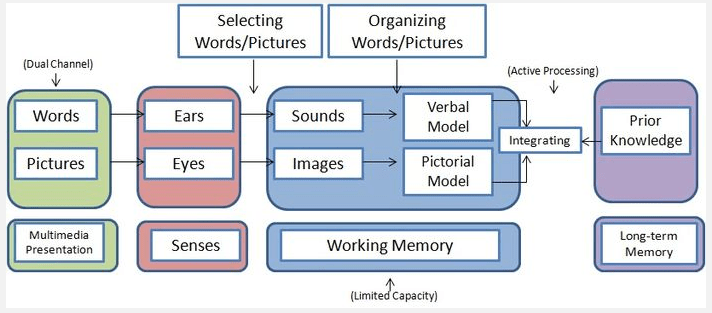
The dual channel assumption states that humans possess two channels for processing information, both visually and auditorily. My project uses both of these methods of delivery in the format of written instructions with screen captures to illustrate the context of the lesson, in conjunction with narrated videos to describe the process.
The limited processing capacity assumption states that humans are limited in the amount of information that can be processed at one time, and that we have an relatively small memory span, which limits our capacity to 5-7 items, plus or minus 2 (Mayer, 2015). I applied this to my e-learning course, by breaking up my instruction into nine unique learning modules, and within those modules, I only featured 3 unique features of the software within each learning module. I designed each learning module to take place over a one week period, so that the learner had time to process smaller segments of the course at a time.
The third assumption of multimedia learning, is active processing. This states that humans actively engage in cognitive processing in order to construct a coherent mental representation of their experiences (Mayer, 2015). My course is designed as a beginners guide to learning desktop music production through Reason software. Although experience with Reason is not mandatory with the course, I do ask for students to meet the prerequisites of prior basic music knowledge and theory. Active processing is a part of the integration of knowledge from past experiences to long term memory. This course revisits music theory and incorporates the foundations of the prerequisites into the lessons and instruction of the course, in an effort to encode this knowledge into long term memory, through application and experience.
Here’s a closer look at some of the principles of multimedia learning that I’ve incorporated into my Bach to Basics course. The multimedia principle states that people learn better from words and pictures, than from words alone (Mayer, 2015). Using a dual channel process allows for visual confirmation and cues to what the learner is reading. I’ve included both visual and written content in my course, in order to visually enhance understanding, and help provide confirmation of the areas within the software, that are being discussed. For this same reason, I’ve incorporated the spatial contiguity principle, which states that learning is improved when corresponding words and pictures are presented near, rather than far, from each other on the page (Mayer, 2015). I’ve incorporated screen shots of the learning topics, as well as videos and written copy, in the same module, in order to create a scaffolding effect of memorization of content.
Another multimedia principle that I’ve incorporated into my Bach to Basics course, is the pre-training principle. This principle states that people learn more deeply from a multimedia message when they know the names and characteristics of the main concepts (Mayer, 2015). I’ve done this in a variety of ways, through vocabulary exams that are based upon a flash card system of glossary terms. I have also created a welcome video that introduces the learner to the topics of the course, as a means of priming their neural pathways for success.
Using the voice principle is another method that I’ve incorporated into this e-learning course. This principle states that learning is improved when the words in a multimedia message are spoken by a friendly human voice rather than a machine voice (Mayer 2015).My client, narrated the practice project videos on each learning module, in a friendly and warm style, in an effort to make learning more fun.
Each of these principles was utilized to enrich the experience for students, in an effort to facilitate retention, investment, and learning outcomes. The Method of Loci is a visualization exercise, to help with associations and memory enhancement. My flippable flash card glossary is a memorization exercise, which students could incorporate the Method of Loci, to help them associate terms and meanings together. This might help them with retrieval of these terms for the vocabulary tests throughout the course.
References:
Mayer, R. (2009). Multimedia learning. Cambridge: Cambridge University Press.
Mayer, R. (2015). 12 Principles of Multimedia Learning. The University of Mississippi. Academic Outreach. Retrieved from: https://elearning.olemiss.edu/12-principles-of-multimedia-learning/
 My Journey Through Instructional Design