Predetermined Objectives and Delivery Methods in Learning Outcomes.

Describe the importance of predetermined objectives and delivery methods of instruction prior to selecting course activities and assignments.

Predetermined objectives and delivery methods are critical to the success of learning outcomes and pedagogical approaches in instructional design, and specifically in blended learning environments. This weeks reading emphasized the importance of this even further for me. My background, prior to Graduate school, was in graphic design, which makes my eyes gravitate towards the function of aesthetics, and the joy of creating. This urges me to want to jump into the development phase quickly, but I realize the importance of spending valuable time on the design phase. The reading this week helped me understand the importance of prioritizing learning outcomes as the first and foremost importance of instructional design. 

During the analysis phase of the ADDIE model, the foundation of a course is examined under an eye of scrutiny and evaluation, in order to help determine the factors that will ensure successful learning outcomes. During this phase, many factors are weighed about student needs, learning environment, appropriate learning theories that are practiced, and technology needs. The course goals and objectives are critical to establish during the needs analysis as well, because they become the framework that guides the design of the course. 

As a student, myself, learning about the vast array of technological solutions and software that is available to instructional designers, I can honestly say that it’s easy to feel guided by the ‘bells and whistles’ of technology, rather than the learning theory behind the design. This is a counterproductive method of instructional design though. According to Sands (2002), the “first principle of developing a blended course is to “work backward from the final course goal,” by seeking to understand what you want students to be able to achieve at the end of the semester. 

Blended learning is a delivery method that offers the opportunity to solve pedagogical problems that traditional courses haven’t been as successful with achieving. It offers the opportunity for students to socialize and engage with one another, combined with the integration of technology, that helps facilitate deeper understanding of concepts. Blended learning has been shown to produce higher scores, longer written papers and projects, and higher achieving student outcomes. In this environment, the activities overlap between the face to face course and the online activities, which extends the students engagement time with the material, and offers more opportunities for deeper learning, asking questions, and engaging with peers. This is an intentional delivery method that is designed for the purpose of increasing academic standards for student learning outcomes. When designing a new course, it is important to note deficiencies in academic practices, that can benefit through intentional course designs such as blended learning environments. 

Predetermined objectives are defined through the process of asking questions that determine the “whats” and “hows” of instructional delivery, which are critical  to the success of learning outcomes and training. The objectives provide a framework with allows both the trainer and the trainee to understand what they will b evaluated upon, the design of the content and procedures of the course, and a method of organizing the students activities within the course.  In addition, predetermined objectives can define an evaluative basis to the depth of learning that must occur in a course as well. Author, Mager (1975), refers to an objective as a “statement describing an instructional outcome, rather than an instructional process or procedure.” By understanding where you are going, ensures a better chance of getting there (Mager, 1975). Objectives provide the framework that establishes how, what and when to evaluate a learner. 

Predetermined objectives and delivery methods are the skeleton of the course. They are the guided and intentional design, that is backed by learning theories and models, with an intentional focus on specific learning outcomes. Technology is the medium in which the content is delivered in an online format, but the designer should never be guided by the parameters of technology. Instructional designers must incorporate educational principles into the design of the course, and be led by the duty to provide superior learning outcomes for students, rather than a mere e-course that looks aesthetically appealing. 

References

Dowling, N.L. & McKinnon, S.H., (Sept. 2002). Instructional Objectives: Improving the success of safety training. Professional Safety. Pg. 41. 

Mager, R.F.,(1975). Preparing Instructional Objectives. 2nd. ed. Belmont, CA: Fearon

Sands, P. (2002.) Inside outside, upside downside: Strategies for connecting online and face-to-face instruction in hybrid courses. Teaching with Technology Today, 8(6).

Reflection-Project B

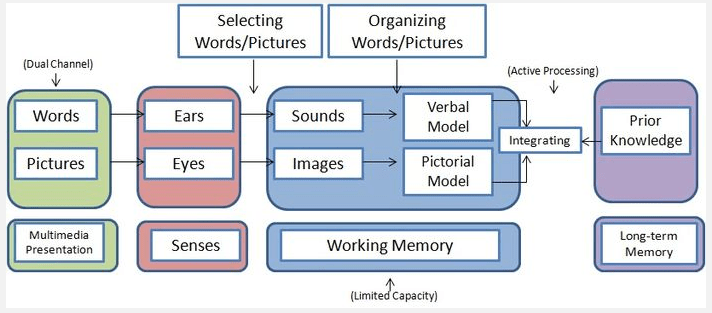
As I work towards finalizing my project B assignment, I am analyzing the principles of multimedia learning that I am incorporating into the project, in order to enhance learning outcomes. There are three assumptions about how people learn, according to Richard Mayer’s Cognitive Theory of Multimedia Learning (CTML) (Mayer, 2015). These three assumptions are :

  1. Dual Channels
  2. Limited Processing Capacity
  3. Active Processing

The dual channel assumption states that humans possess two channels for processing information, both visually and auditorily. My project uses both of these methods of delivery in the format of written instructions with screen captures to illustrate the context of the lesson, in conjunction with narrated videos to describe the process.

The limited processing capacity assumption states that humans are limited in the amount of information that can be processed at one time, and that we have an relatively small memory span, which limits our capacity to 5-7 items, plus or minus 2 (Mayer, 2015). I applied this to my e-learning course, by breaking up my instruction into nine unique learning modules, and within those modules, I only featured 3 unique features of the software within each learning module. I designed each learning module to take place over a one week period, so that the learner had time to process smaller segments of the course at a time.

The third assumption of multimedia learning, is active processing. This states that humans actively engage in cognitive processing in order to construct a coherent mental representation of their experiences (Mayer, 2015). My course is designed as a beginners guide to learning desktop music production through Reason software. Although experience with Reason is not mandatory with the course, I do ask for students to meet the prerequisites of prior basic music knowledge and theory. Active processing is a part of the integration of knowledge from past experiences to long term memory. This course revisits music theory and incorporates the foundations of the prerequisites into the lessons and instruction of the course, in an effort to encode this knowledge into long term memory, through application and experience.

Here’s a closer look at some of the principles of multimedia learning that I’ve incorporated into my Bach to Basics course. The multimedia principle states that people learn better from words and pictures, than from words alone (Mayer, 2015). Using a dual channel process allows for visual confirmation and cues to what the learner is reading. I’ve included both visual and written content in my course, in order to visually enhance understanding, and help provide confirmation of the areas within the software, that are being discussed. For this same reason, I’ve incorporated the spatial contiguity principle, which states that learning is improved when corresponding words and pictures are presented near, rather than far, from each other on the page (Mayer, 2015). I’ve incorporated screen shots of the learning topics, as well as videos and written copy, in the same module, in order to create a scaffolding effect of memorization of content.

Another multimedia principle that I’ve incorporated into my Bach to Basics course, is the pre-training principle. This principle states that people learn more deeply from a multimedia message when they know the names and characteristics of the main concepts (Mayer, 2015). I’ve done this in a variety of ways, through vocabulary exams that are based upon a flash card system of glossary terms. I have also created a welcome video that introduces the learner to the topics of the course, as a means of priming their neural pathways for success.

Using the voice principle is another method that I’ve incorporated into this e-learning course. This principle states that learning is improved when the words in a multimedia message are spoken by a friendly human voice rather than a machine voice (Mayer 2015).My client, narrated the practice project videos on each learning module, in a friendly and warm style, in an effort to make learning more fun.

Each of these principles was utilized to enrich the experience for students, in an effort to facilitate retention, investment, and learning outcomes. The Method of Loci is a visualization exercise, to help with associations and memory enhancement. My flippable flash card glossary is a memorization exercise, which students could incorporate the Method of Loci, to help them associate terms and meanings together. This might help them with retrieval of these terms for the vocabulary tests throughout the course.

References:

Mayer, R. (2009).  Multimedia learning.  Cambridge: Cambridge University Press.

Mayer, R. (2015).  12 Principles of Multimedia Learning. The University of Mississippi. Academic Outreach. Retrieved from: https://elearning.olemiss.edu/12-principles-of-multimedia-learning/

https://en.wikipedia.org/wiki/Method_of_loci

Week 14 Reflection Method of Loci – Take Two

In this weeks’ effort to sit quietly, and practice the Method of Loci, I took a different approach. The first time that I attempted this exercise, I was too literal with my visualization. I couldn’t separate my vision of the place that I was thinking about, from the exercise that I was working through. My hobbies often include interior design, and it’s hard for me to think about interior spaces in a different context. This time, my approach was much more illustrative, than literal.

As I sat quietly and worked through the Method of Loci relaxation and visualization exercise, I found myself assigning “context” to spaces as I visualized them, in order to help me focus on the purpose of this exercise. The context that I was working through was the ADDIE model, and so each step of the model was assigned a different “space” in my visual exploration.

Starting from outside of the front door, I pictured the “analysis” component of the ADDIE model. I visualized my client, and their needs in a product. How can I “open doors” to new methods of learning, and informing their audience, through my instructional product. I wanted to meet, and exceed, the goals that they had in mind, and provide elevated levels of education for their target students.

My next step, once I walk through that “door” is the “design.” I visualized walking around the entire space and getting a feel for the needs of the end user. How do they want the “space” to make them feel and what their “use” of the space should be. At this point, I visualized how I would improve upon, or help deliver electronic information and educational content, through an e-learning platform, for my client.

Advancing forward, after the design phase, I visualized the “development” of the project. Through the steps of the Method of Loci, I translated this process as a mental exercise of moving furniture around a room, in order to better accommodate the layout and the residents, utilizing the space. In an analogy of interior design, this is the equivalent of deciding if the furnishings are “right for the space” or if we need new furnishings in order to achieve the desired goal. Within instructional design, we must look at the content that is available to us, and decide if that is the correct delivery of information, or if we need new content. Is the delivery method effective, and does it enhance the learning outcome for students? Does it simplify and make sense in the space that it occupies?

The fourth step in the ADDIE model is the implementation step. I visualized this as the process in interior design where the designer is shopping for the new furnishings for the space. What measurements, colors, textures, and angles are going to achieve the desired impact for the client? This is the form vs. function step. You must research delivery methods, for the LMS. You must decide what content should be included, and how to achieve that content. You must establish timelines and organization to the project, in order to meet deadlines and goals. This is the “how, what, and why” phase.

And last, is the Evaluation step. This is the “make it or break it” moment in the project! In the exercise, I envisioned sitting on the brand new sofa, that was delivered for this space. I imagined the light coming in, early in the morning, and how the client would feel in their brand new space. This step, is the first test-drive of the new project that you are delivering to the client. This will determine how well you understand your clients’ needs, goals, and students.

In my visualization, I imagined my client sitting relaxed in their newly designed space, sipping on a nice cup of coffee, with a smile on their face. This will be my goal in all projects!

Self-Regulation

What does it mean to manage/regulate yourself (self-regulate) and others during learning experiences? How does it bring you towards goals? How important is communication in this process and what helps/impedes it?

Source: https://www.yourtherapysource.com/blog1/2019/11/05/self-regulation-activities-for-elementary-students/

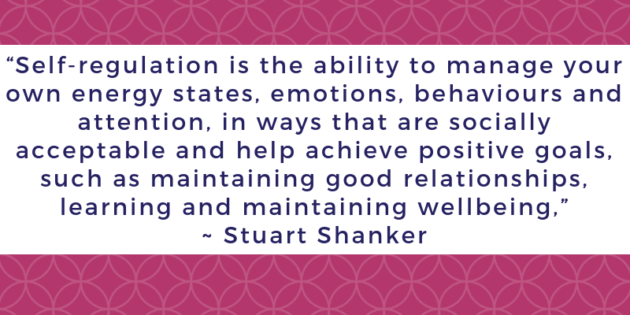
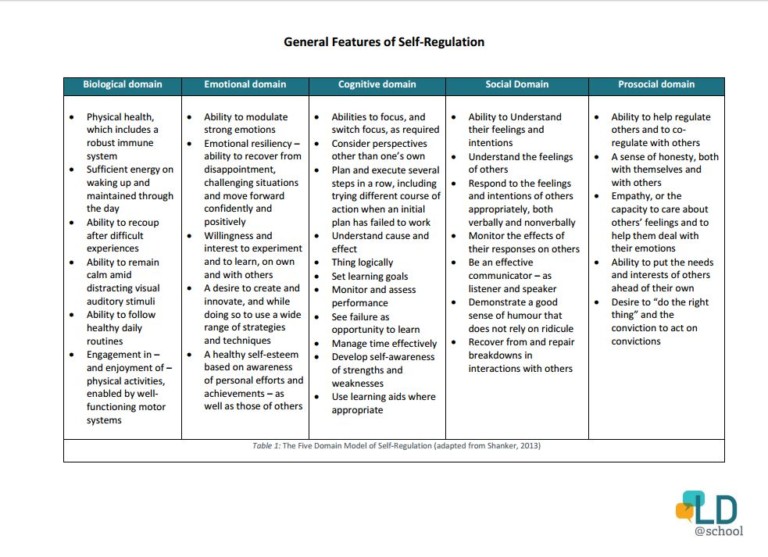
Self-regulation is a critical component to the learning process, and a pivotal aspect to finding balance for successful outcomes in all areas of life. Merriam-Webster defines self-regulation as the act or condition of bringing oneself into a state of order, method, or uniformity. As a graduate student, enduring the sudden pressure of navigating through the uncertainty of the COVID-19 crisis, I must take this opportunity to quietly reassess and evaluate stressors in my everyday life. Now, more than ever, I must find balance and prioritize my time for activities that bring value, peace, and order to my life.

The unplanned events in life, can periodically be like a roller coaster. We all endure periods of highs and lows throughout our unique timelines. This creates a challenge in finding work-life balance through these storms. You can feel like you are on top of the world, and every door is opening up for you with ease, or like every door is slamming in your face, no matter how hard you try to achieve something. The human experience packs our 80+ years of existence with so many exciting twists and turns, from marriage, birth announcements, break-ups, graduations, career changes, new homes, or even death of a loved one. These major life events don’t always occur during times that are most convenient. We are simultaneously dealing with various types of fear, grief, insecurity, overwhelm, depression, medical issues, extreme joy, moving stress, personal conflicts and loneliness, to name a few. Some of these emotions make learning more difficult to achieve. When life is weighing you down with burdens, you may portray non-verbal body language to others, which communicates your feelings more powerfully than the words you use. So how do we continue to push forward during these times in our lives, when we feel small and unable to manage the pressure? Clear communication is a vital component of a learning environment. Student success starts with how we speak to ourselves and our inner dialog channels our success or failure. Feedback from educators or class peers, is another form of communication that is vital to learning outcomes, in order to gain a broader perspective and guidance.

Grad school has shown me that I have it inside of me, to push through challenges, even when I’ve felt like I would crumble and fall. Self-regulation is the way in which people regulate their emotions, cognitions, behaviors, and environment, during a learning experience. “Learning is about one’s relationship with oneself and one’s ability to exert the effort, self-control, and critical self-assessment necessary to achieve the best possible results.”(Linda B. Nilson)

Self-regulated learning involves attaining both knowledge of an ability, as well as other skills such as self-awareness, self-motivation, and the ability to apply what you learned appropriately. Self-regulation consists of applying a specific set of processes selectively to each learning task, based upon personal reflection. Despite the fact that these skills are essential tools for learning, they are rarely taught by educators, which may explain why many students lack independence, motivation, persistence, or a sense of well-being during their academic studies. Students must become familiarized with the most important aspects of self-regulation, which include: planning, performing, and reflecting. This process involves understanding your own emotional response to stress and, setting goals that are achievable despite challenges that you are faced with. It is important for students to learn how to self-monitor their own performance, restructure techniques if unable to meet goals, and provide reflection and detailed instructions to guide themselves through tasks, judge the quality of their own performance, and impose consequences for success or failure. During the reflection stage, students must think about feedback and concepts that can be used in the future, to strengthen learning outcomes. In addition, students must learn to use their time efficiently, evaluate the methods utilized, and be willing to adapt these methods for future learning, as needed.

References:

https://www.change-management-coach.com/self-regulation.html

https://exploringyourmind.com/self-regulated-learning-important/

https://www.ldatschool.ca/introduction-self-regulation/

https://www.psychologytoday.com/us/blog/anger-in-the-age-entitlement/201110/self-regulation

https://www.yourtherapysource.com/product/student-self-regulation-rubrics/

ADDIE Reflection

As I place the finishing touches on project A, and release her as a completed project, I am filled with feelings of satisfaction, relief, and gratitude. What a great accomplishment, to work through the steps of the ADDIE framework, and finalize an instructional project from concept to completion. My project was an instructional module and assessment tool, for the Texas Great Pyrenees Group, dog rescue, which offers adopters the opportunity for 24 hour access to the agency, to begin their quest into dog adoption. The goal of my client, was to create an environment where their adopters were better informed about the dogs needs, and give them the opportunity to see for themselves, if they can make the sacrifices needed, in order to adopt the large breed. My greatest takeaway from this project is detail! The ADDIE framework forces you to confront each of the obstacles that you are surely to encounter along the way, whether that be budget, technology, learning needs, or concept. By working directly with my client on a monthly or weekly basis, throughout the first 9 weeks of this semester, I’ve been able to probe deeper into the needs and deficiencies that the client has been experiencing, and was granted an opportunity to creatively offer them an alternate method of education to their potential adopters.

I admit that there were some weeks where I felt a bit repetitive in the process, and somewhat confused about how to make forward momentum in the project that week, but that was most likely due to the nature of my project, as a slightly irregular learning module. Going into project B, I feel that many of these steps will need to be consolidated in order to meet the deadline for a second project submission in 6 weeks. I have thoroughly enjoyed working with the client, and seeking out innovative ways to meet the project goals, while respecting budget constraints and seeking out various types of technology needed to deliver the product. It’s a satisfying feeling to launch a project, and feel the excitement of a satisfied client as they take it on a test run! My hopes are that this will be a useful tool that can be incorporated into the TGPR adoption process, and help them find successful matches for their beautiful dogs.

As I prepare to navigate into the beginning of project B, my thoughts have been drifting in and out of the ADDIE framework, in my mind, and how to approach this project. I would like to use a different technology for this project, in order to diversify my portfolio, and work through a different technology platform. I believe that efficiency will be vital to meeting the deadline, and after working through ADDIE from beginning to end, I’ll have a better grasp on the types of questions I need to ask the client, in order to drive the project successfully forward each week, in order to better facilitate the condensed timeline on project B. The part that really helped me organize my finished project, was the design document. Once I had that put together as a road map of goals, it really helped shape every decision made from that point forward. I initially planned on using Talent LMS for project A, but once I determined that it required a user to set up each ‘student’, this created a conflict for the client, and I was able to make the decision to change to an open platform Google slide document, that wasn’t restrictive to users, in order to better suit the clients’ needs. My weakest point in this process, was in my full grasp on the parameters of this project from the beginning of the semester. I went all the way to the implementation/ evaluation step before realizing that this was to become a fully working instructional module, and not just the design document. Moving forward into project B, I will certainly start integrating the creation of the electronic project, simultaneously with the design document, while working through ADDIE, so that I can test out the limitations of technology while I am designing. By doing this, I believe it will improve my efficiency and help focus my project on the correct solution from the beginning.

COVID 19

What a surreal and inimaginable twist that this semester has taken. I would have never imagined that a coronavirus, of this magnitude and mystery, would be sweeping through, continent after continent, wreaking havoc on thousands of people’s lives. As I wake each morning, over these past couple weeks, I find myself taking longer to bask in the gentle morning sunlight coming through my curtains. As my eyes loosen to cat like slits in my face, and I’m greeted by puppy breath and the repetitive thud of a happily wagging dog tail. I have a moment of feeling like the world is whole again. But as more sunlight pulls my eyelids open, my mind realizes that the world waiting outside of my front door, is one where we need to Clorox every surface in a gesture of life and death diligence.

Each day that passes, since this virus entered the US borders, carries with it Presidential press conferences, new COVID tracking websites, and an onslaught of dismal facts every moment of the day on social media. We are being inundated with fact and fiction, orders and recommendations, urgency and stress. How do we defeat this thing that has turned our world upside down? Working at a large University makes you hyper aware of your surroundings. During a normal day, you are expected to know how to do the duties of your job, how to maneuver across campus and give those who are lost, viable instructions to one of many buildings across campus. You are expected to attend numerous meetings each day, and be safety aware, in the event of a shooter, a fire, and a tornado. But nowhere were we trained for this. We are suddenly thrust into a world here Clorox wipes are either sold out, or selling for $25 per package. Each morning starts with a diligent run of disinfectant across every door handle, stapler, public pen, desk surface, keyboard, xerox machine, sink faucet, cabinet doors, office doors, etc. The echoes of empty parking lots and buildings is an eerie sight to behold, and never in my 14 year history on campus, have I ever seen anything like this.

I feel fortunate that this academic program is online, which brings me a sense of comfort. This is one aspect of my life that isn’t suddenly changed. It also brings me a great sense of urgency, that there is a need for this training in the world and I want to be part of the solutions in our country’s’ future. Classes that were face to face, are now converting to an online format, and I believe that we’ve entered a threshold of a great transition in higher education courses. The opportunity for programs to discover new ways of teaching online forces change and evolution, and this has certainly pushed every one of us out of our comfort zones. I find myself seeking out innovative ways to transition how things were done, to how they could be done. This academic program is one area of my life that is currently bringing me excitement about the future, once we find post COVID-normal again.

Reflection: Method of Loci

I struggled with this process. That shouldn’t be the case, I’m a visual person, so this should come easy for me, but somewhere in the intricate wiring of my mind, my brain drifts off into the need to decorate the areas that I’m visualizing. The Method of Loci is based on the idea that you will be able to remember places that you are familiar with, so by linking something you need to remember with a place that you know very well, the location will serve as a clue that will help you to remember. Unless you are me, and my mind gravitates towards ceiling beams, shiplap walls, and interior color. I sat in the floor, like an ancient yogi, while my husband read Activity 5 out loud to me, while attempting to visualize doorways, windows, and features of my favorite room in my house. I said to myself, “you just need to relax,” “take a deep breath, or ten, and count backwards.” Now try again, just relax and visualize. Somewhere between the chaos of a world where people are jaunting out their front doors in the hopes of buying the last roll of toilet paper on the shelves at Kroger, I can’t seem to get into a blank enough head space to connect the pieces of this process together. So I sat down, and I mapped out flow charts and grids, to help me focus on the task at hand. In my attempt to do this, I came to the conclusion that the front door is represented by the concepts of learning, which encompass the notions of access for all students, learner centered, engagement, and a vast wealth of knowledge at your fingertips. This doorway represents the entry to online learning, and things that must be present, in order to bring validity and purpose to the process. The next step is in visualizing the second familiar feature, which is at the end of my entry hallway, opposite the front door. Seated at the dining table are the teachers, and seated at the sofa, are the students. The dining table represents a platform for serving up the various “offerings”, and in this case it is information. The sofa represents those that are waiting to be served. The teachers at the table, have wasted their efforts to “serve” if they don’t have students who enjoy what is being “offered.” As the students approach the table with the teachers, they look closely at each serving platter, which contains the goals that each party wants to receive. Goals such as, accessibility to current technology, an engaged community, valued feedback, challenge and growth, and relevant content, are all filling the table, and both students and teachers look contented by the students filling their plates. In the kitchen, are the chefs, cooking up new methods of using the technology, to create new dishes for the students and teachers to learn from. There is a symbiosis in this scenario, where we are all interdependent on each other, to use technology in new and innovative ways, to solve problems, answer questions, serve one another, and overcome boundaries that previously held us back. I will continue to practice this method, and as the world finds its way back to a state of normalcy again, I believe that this will get easier for me.

(ID) and Me

A simple question, “What do I think about Instructional Design so far?” This seems like a simple and benign question to pose, but as I reflect upon this, I find that it’s a much more complex topic. I came into this degree with a basic idea, that I would be incorporating technology into the learning process, to help facilitate others on their learning paths. While this still holds true, I’ve now become better acquainted with the creative side of instructional design, which is speaking directly to my heart. I’ve had opportunities to write research papers on numerous interesting topics, such as the study of playing stringed instruments and the impact on memory. I’ve been able to create visually interesting and informative presentations using numerous creative presentation platforms, and I’ve been able to design conceptual projects, that I can see as a feasible and functional addition to this worlds’ long list of beneficial technology. These opportunities have opened my mind to the endless learning possibilities that technology helps to create. I can feel myself looking at the world differently now, and wanting to contribute and refine methods of disseminating information to learners. My background in education, has always been in the role of the student, not in the chair of the instructor. This lack of familiarity to that role, makes the “educator” title still feel quite foreign to me. I have always had an active and creative mind, and been lured towards entrepreneurial endeavors on more than one occasion in my life. I find the creation of content, and methods of delivery of information to be the aspect that I’m feeling most excited about at this point in my Master’s’ journey. I have spent the past 13 years of my life, in an environmental research arena, which I feel has influenced me, and broadened my awareness of impact on the planet, human health, and ways to invoke change at the community level. I believe that this model is important in all areas of life, and I see how this foundation crosses over into instructional design, and the desire to invoke change through learning methodologies. I’m currently in my second semester of this Masters program, in Instructional System Design, and I feel that I’ve only touched the tip of the iceberg on what I will learn throughout the duration of this program. My current position on this question, is that I feel encouraged, challenged, and excited about the learning process, upcoming projects, and becoming acquainted with new technologies that will better equip me for this career path. I’ve had opportunities to work in team collaborations, which I’ve come away feeling impressed with my peers, and feel like each variance in perspective has had a valuable contribution to the project as a whole. I still feel extremely encouraged that I’m on the correct career path for my life, and looking forward to what’s next. I’ve also learned a valuable lesson in my life, up through this point. Every aspect of my life has had a scaffolding effect, that has overlapped and built off of the one that came before it. I’ve explored the arts through graphic design. I’ve explored my love of beautiful aesthetics through floral design and photography. And I’ve explored my desire to make a positive impact on this planet through my job in environmental science. I see overlapping opportunities to learn in everything new that I’ve approached, such as bees and floral, and shapes in nature guiding art principles. There are opportunities to learn all around us, if we are open to see it. Below is an example of many pieces of my life coming together through one of my graphic design compositions. Just as instructional design pulls from multimedia resources to create a deeper level of understanding, I created this piece for a similar reason. I used my photography, to capture a photo of flowers growing in my garden, and my artistic inspiration of Frida Kahlo, as my subject who represents juxtapositioning between beauty and pain, while building the entire composition from hexagonal shapes, similar to the construction of a colony of bees. I believe that this is a representation of the construction of my life, and instructional design has become another building block to guide my creative path.

Analysis + Design

As I reflect back upon the past couple weeks in class, our course objective has been the process of analyzing a clients’ needs for an instructional design project. I have felt challenged by this step in the process. It hasn’t been a challenge with presenting a concept, finding an issue, or proposing potential solutions. My biggest challenge, has been something that has persistently confronted me as a designer, which is the challenge of having patience throughout the entirety of the design process. The ADDIE framework has forced me to slow down and be fully present throughout the steps of the analysis. I am reminded of my journey through graphic design, and how I would be presented with a ‘project concept’ and then my mind would start “sketching” solutions in my imagination. Part of that creative process was to create thumbnail sketches of ideas, so that I could physically work through sketching out potential solutions for the project, but my lack of patience would frequently draw me to the computer to start working up ideas without thumbnails to build upon first. By skipping this step in the process, it doesn’t allow you to slow down and see the problem through any other lens, except your minds eye. By working through this analysis process, I was placed in a position to ask questions, seek solutions, and trust myself as a designer and educator. The analysis gave me the framework to look through the eyes of the client, find areas lacking in their current content, to seek out redundancy and better methods of delivering information to their end user, in a more informed and methodological format. Although my mind still builds a preliminary framework in my head, there is value in working through the steps, speaking to the client, and evaluating their needs to ensure that all objectives are met successfully.

I am starting to feel the shaping process of learning instructional design. From a foundational standpoint, I learned the elements of design many years ago, and on a subconscious level, I’m always aware of the use of shape, form, color, texture, line, movement, and scale, in the world around me. I’ve always put those elements into the “box” of right brained thinking, but instructional design is teaching me how to weave those elements into an analytical, left brained space, and I find it exciting and challenging at the same time. While design covers the aesthetics of an instructional course, it also comes with the solutions to the question “how?” In the realm of instructional design, both analysis and design must dwell in the same space together. You must weave together logic, language, psychology, instruction, and methodology, into the same fabric that contains images, audio, creative content, and inquiry, in a way that illuminates the learner and results in retention. Years of criticism about using media as a method of learning, and we are still posing the question of it’s value still today. Perhaps media can’t force learning, but there is a reason that our predecessors drew on cave walls as a means of telling a story and informing others about their surroundings. What must have seemed trivial at the time, so many years ago, is still a tool for us today, to learn about cultures and civilizations. The integration of multi-media in education, enables us to look into places and spaces that no static classroom can take us.

Personal Theory of Learning

Learning is the cognitive process of inputing, rehearsing, and retaining various bits of information to be stored in our long term memory. It is built upon by use of tools, techniques, theories, and prior experiences, throughout our lives. As we go through each day of our life, we are inundated with information about various “things”, but intimate knowledge about a topic requires a different level of investment and rehearsal, than merely knowledge of the “thing” itself. Learning occurs at the intersection of investment of time, and proper tools to reinforce that learning outcome. I believe that this learning model is most akin to the Constructivism model, where learning is a process of constructing knowledge by an individual, in an active learner-centered environment (Leidner, D. E., & Jarvenpaa, S. L. 1995).

In corporate settings, “learning and development processes provide a way of developing those in the organization to be ready to meet challenges” (Page-Tickell, R., 2014). Value is placed upon the person who applies themselves to meet the goal of learning new tasks. Cultural and societal paradigms play a role in influencing others, and how far they may push themselves to learn new information. American author, John Holt said “Learning is not the product of teaching. Learning is the product of the activity of learners.”

In today’s technology driven environment, where more students are enrolled in online classes, and less frequently engaged face to face with a classroom, what does this mean for the role of teachers? Students’ become empowered by their own learning outcomes, and the teacher takes the role of mentor and guide, to help the student navigate through learning objectives. Teachers develop engaging curriculum, which is central to the work of teacher educators” (Seiki, S., 2016). Many traditional K-12 classrooms incorporate a Pedagogical Learning model, which transfers knowledge incrementally, while noting individual achievements for high performing students. This model is effective at this level of education, because it’s more interested in ensuring that students are meeting particular learning goals. Inonline learning platforms, an adaptive cognitive-based learning model may be more conducive, because there may be numerous backgrounds that joined those students together in that environment, and they may all have different learning goals. A teacher who understands the needs of her students, and has a broad range of teaching tools to draw from, is ultimately the best teacher. As seen in Gibson’s affordances, different theories must be applied in different situations, due to perceptual differences (Greeno, J. G., 1994).

No paradigm for research ever solves all of the problems that it defines.(Driscoll, M., 1995).” There are no two students that have the exact same needs in a classroom. The role of educators is to be equipped with understanding about cognitive theories, and tools that can provide methods to help bring understanding and improve learning outcomes for all students.Evaluative methods on the output of Instructional Design is still in its infancy, and scientists are conducting research to gain valuable insight on the most effective methodologies. If we widen our views to the vastness of the technology that is developing around us, we can see that there are limitless possibilities before us.

I originally took LTEC 5030 this past Fall, and wrote my personal theory of learning in November 2019. In this weeks’ reading (Leidner, D.E, & Jarvenpaa, S.L. (1995), I’ve gained understanding and appreciation for the five Learning Models: Objectivism, Constructivism, Collaborativism, Cognitive Information Processing, and Socioculturism. As a designer, I believe that Instructional Design (ID) must evaluate curriculum and make decisions about how to incorporate each of the models into the appropriate instructional setting. Just as each trade has its tools that it must utilize in order to perform the functions of that job, I believe that these Learning Models are the tools of the Instructional Designer. ID’s must know their client and learners needs, and create instruction which encompasses the proper strategies that helps ensure those learning outcomes.

REFERENCES

Driscoll, M. (1995). Paradigms for research in instructional systems. Libraries Unlimited, Inc.

Greeno, J. G. (1994). Gibson’s affordances. Psychological Review,101(2), 336–342. https://libproxy.library.unt.edu:2147/10.1037/0033-295X.101.2.336

Leidner, D. E., & Jarvenpaa, S. L. (1995). The use of information technology to enhance management school education: A theoretical view. MIS quarterly, 265-291.

Page-Tickell, R. (2014).Learning and Development (Vol. 1st edition). London: Kogan Page. http://libproxy.library.unt.edu:2066/login.aspxdirect=true&db=nlebk&AN=801724&scope=site

Seiki, S. (2016). Chapter 2: Transformative Curriculum Making. Curriculum & Teaching Dialogue, 18(1/2), 11–24.

Design a site like this with WordPress.com
Get started